Thursday, December 12, 2013

Happy Antarctica Day!

Welcome, all Antarctica Day celebrants!

Today's big event was a group departure for my project. The four drillers were scheduled to leave two days ago and Gonzalo, one of my co-workers, was supposed to leave yesterday, but the last two flights were cancelled. All of them were ready to leave today!

The plane was due in just after noon, so everyone had a leisurely lunch then got dressed and assembled at DA (Destination Alpha, one of two main exits for the station). After waiting about 15-20 minutes, an announcement on the station PA instructed all passengers to proceed to the departure area.


Ralf gave them a South Pole limo ride from the station to the departure point, then everyone wandered around saying their goodbyes. It seemed to take a LOOONG time before they announced that passengers could board.

The first movement we saw was one of the cargo loaders moving its load back to the cargo shed, followed by another loader taking the baggage off the plane. The plane had trouble with its hydraulic system and the crew were worried about landing in McMurdo with passengers or the extra cargo weight. So everyone is spending an extra night at the Pole!

In other news, we've been told to expect visitors to the tourist camp in about 30 hours or so. This will add to an already busy weekend. The South Pole Telescope is holding their annual open house tomorrow night and the South Pole Marathon will be held on Sunday. After all that frivolity, I'll be ready to leave for McMurdo on Monday so I can get some rest! (Although seeing the current problems with getting planes to Pole and back, I'll consider myself lucky if I make it home by Christmas!)

Wednesday, December 11, 2013

Travel

Travel in Antarctica always has a degree of uncertainty because weather can change in an hour or two and make it difficult to land at the other end. The Wisconsin drillers were scheduled to leave yesterday but that flight was cancelled and today's flight has also been cancelled due to weather.

My flight is already changing even though I'm not leaving for almost a week. My departure date has been bumped up a day, from the 17th to the 16th. I've heard that this is because they're making fewer flights between Pole and McMurdo, and between McMurdo and Christchurch.

Flight in Antarctica always involves a "bag drag". Here at the South Pole, instead of showing up at the airport an hour before the flight and checking in my luggage, I'll need to walk out to the Cargo shed by 3PM the (work) day before my flight with my checked bag. That bag will be weighed and taken away, and I won't see it until several hours after I've landed on the other end.


Since I'm now leaving sometime on Monday and Cargo is closed on Sunday, I'll need to be packed by 2:30PM Saturday. Of course, my flight might get bumped a day or two so I might not really leave until Tuesday or Wednesday. There's also a chance that they'll try to put me on the next flight out of McMurdo, so I might not see my checked bag until Christchurch. This means that I need to plan to be without my checked bag for at least 4 days. I'm already planning on doing laundry tomorrow so it'll be dry on Saturday and making sure I finish up all the work I wanted to get done here at Pole.

There's been no sign of any of the British groups here at Pole, but we did have a minor British Invasion. One of the new arrivals brought in a copy of "Day of the Doctor", the latest Doctor Who episode which aired everywhere else around Thanksgiving. Last night there was a showing in the downstairs lounge. I already feel like I'm back in civilization!

Tuesday, December 10, 2013

Being green

For you snow-bound people, here's some greenery from the South Pole.


Since there are no flights for at least 8 months, the greenhouse is the only source of fresh fruits and vegetables, referred to as "freshies" here.


The greenhouse area is also delightfully humid so it's not unusual to see someone sitting on the couch inside the greenhouse, soaking up some moisture.


In other news Bill Spindler, who runs www.southpolestation.com pointed me at this article which explains everything you could every want to know about raising and leveling the station. It's a bit technical, but still a fun article if you're interested.

Also, we've cleaned up our area here in the station and Ian is working on a short IceCube presentation because we've been told to expect British media on station in the next couple of days. So maybe I'll get to see McNulty after all!

That last item is particularly important to me because my departure from Pole has been moved from Tuesday to Monday (5 days from now). For some reason I still don't understand, instead of an overnight stay we now need to spend two days in McMurdo on the way out.

So I'm rushing to finish the big task I'd hoped to complete on this visit, but I think that's been true of every visit to the Pole :-)

Monday, December 09, 2013

Snow removal

I've been hearing about the snow in the Midwest so I thought I'd make you all feel better about the amount you have to shovel.

All winter long, snow blows across the Antarctic continent, stopping only when it drifts against some obstacle. Unfortunately, the buildings at the Pole are major obstacles, so we end up having large drifts. One of the jobs here at the start of the summer season is moving all that snow.


Before any planes arrive, the winter-overs have to get the heavy machinery warmed up and then they need to clear off the runway so the first planes can land. They also clear away the drifts which have blown up against all the buildings.

One of the last buildings to be cleared is the main station, officially known as the Elevated Station. As you can see, the entire station is built on pillars so tractors can drive underneath and clear out the drifted snow. This will hold off the snow for a couple of decades but eventually the snow behind the station will be too high. When that happens, The station is designed so that the entire thing can be raised. I'm not sure if they'll add more segments to the pillars or if they'll just jack up the station, haul in and pack down a bunch of snow and then place the pillars on the newly packed snow.

Hopefully, this station can avoid the fate of the old station which, as I wrote earlier, is now buried under 20-30 feet on snow. Ian, one of the IceCube winterovers succeeded in getting a picture of the explosion which further buried the old station


If you'd like to learn more about Old Pole or other Antarctic details, the www.southpolestation.com website has more details about the Old Pole station and details of both Antarctic history and current goings-on!

Sunday, December 08, 2013

Energy

On Friday night Kyle Hoppe, the ASC energy engineer gave a talk about the past, present, and future of energy use on Antarctica. They've done much to reduce energy use everywhere (no-flush urinals, high efficiency lights, etc.) and are working on new ways to save and create energy.

They're examining the environmental impact of an incinerator for McMurdo. It would burn cardboard and wood products which would otherwise need to be shipped back North for recycling.

McMurdo and neighboring Scott Base (run by New Zealand) already have a common power grid. Antarctica New Zealand is eager to add 5 windmills in addition to the 3 which are already running and supplying most of Scott Base's energy needs.

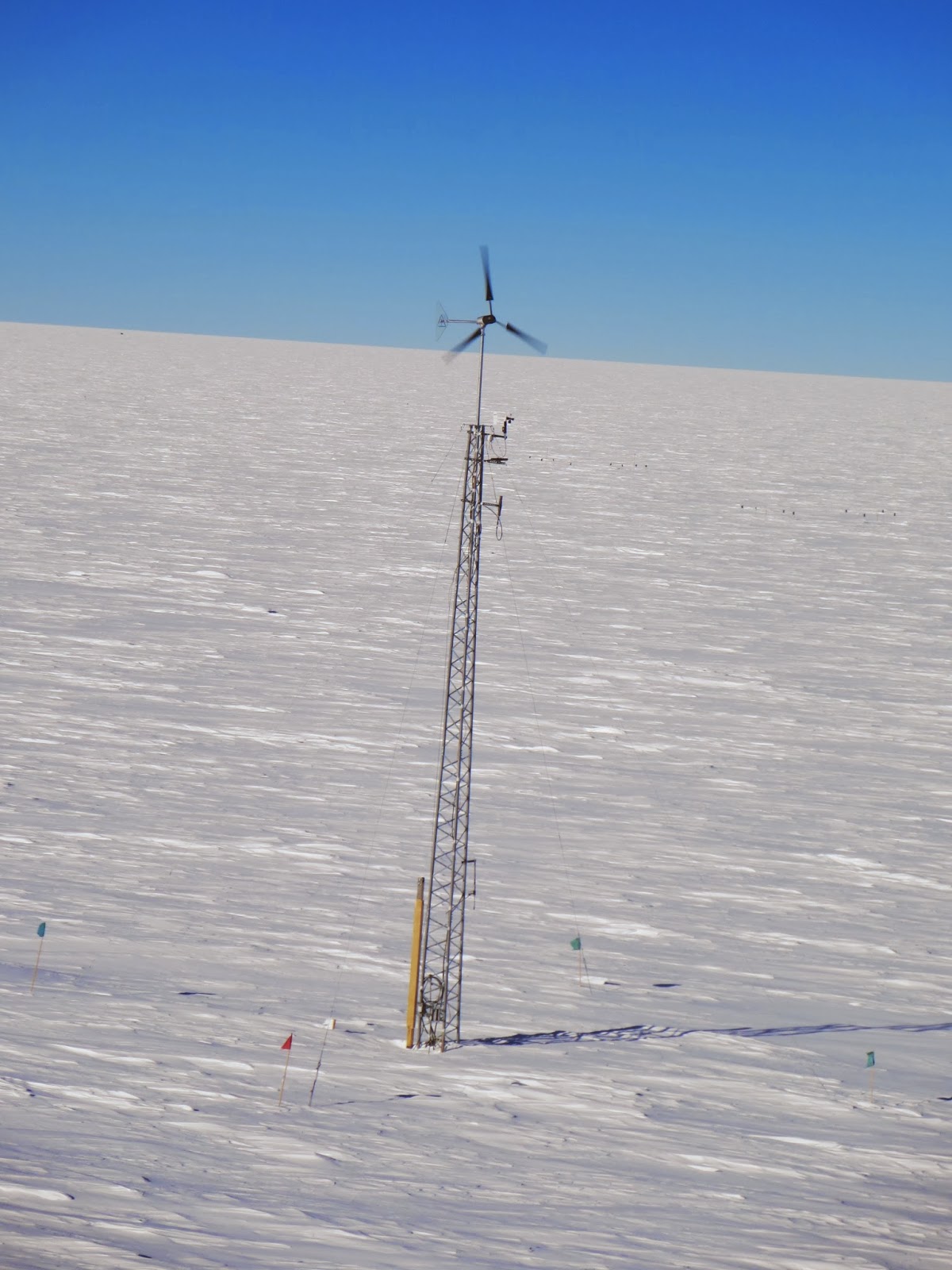
Windmills are apparently major sources of EMI (electro-magnetic interference), which has kept them from being used at Pole due to all the sensitive scientific instruments. Companies are starting to market products to filter the EMI produced so we might see large windmills at the Pole in the next decade.

WIPAC (the new UW supergroup which includes IceCube) are doing their part. Part of my job this season is helping to install new servers which are more powerful but also more energy efficient.

The Askaryen Radio Array is a 5 kilometer neutrino detector located above and beyond IceCube. They're still in the experimental phase, but because their instruments are located so far from the station they're looking at using a combination of windmills and batteries to power these distant stations.


My colleague Matt Newcomb is looking at adding solar panels to the two ICL towers. These would wrap completely around the towers and provide power all summer long

Saturday, December 07, 2013

Swedish camera

The cables for the IceCube strings are over a mile and a half long. The 60 sensors (digital optical modules, or DOMs) on each string are spread across a kilometer of cable. The detector has to be spread out because we want to capture as much information about as many neutrinos as we possibly can.


While IceCube was putting strings in the ice, there was a unique opportunity for people to install additional things in the spaces between DOMs. I don't know exact numbers, but it seems like almost a third of the strings had some sort of special device installed, some more successful than others.

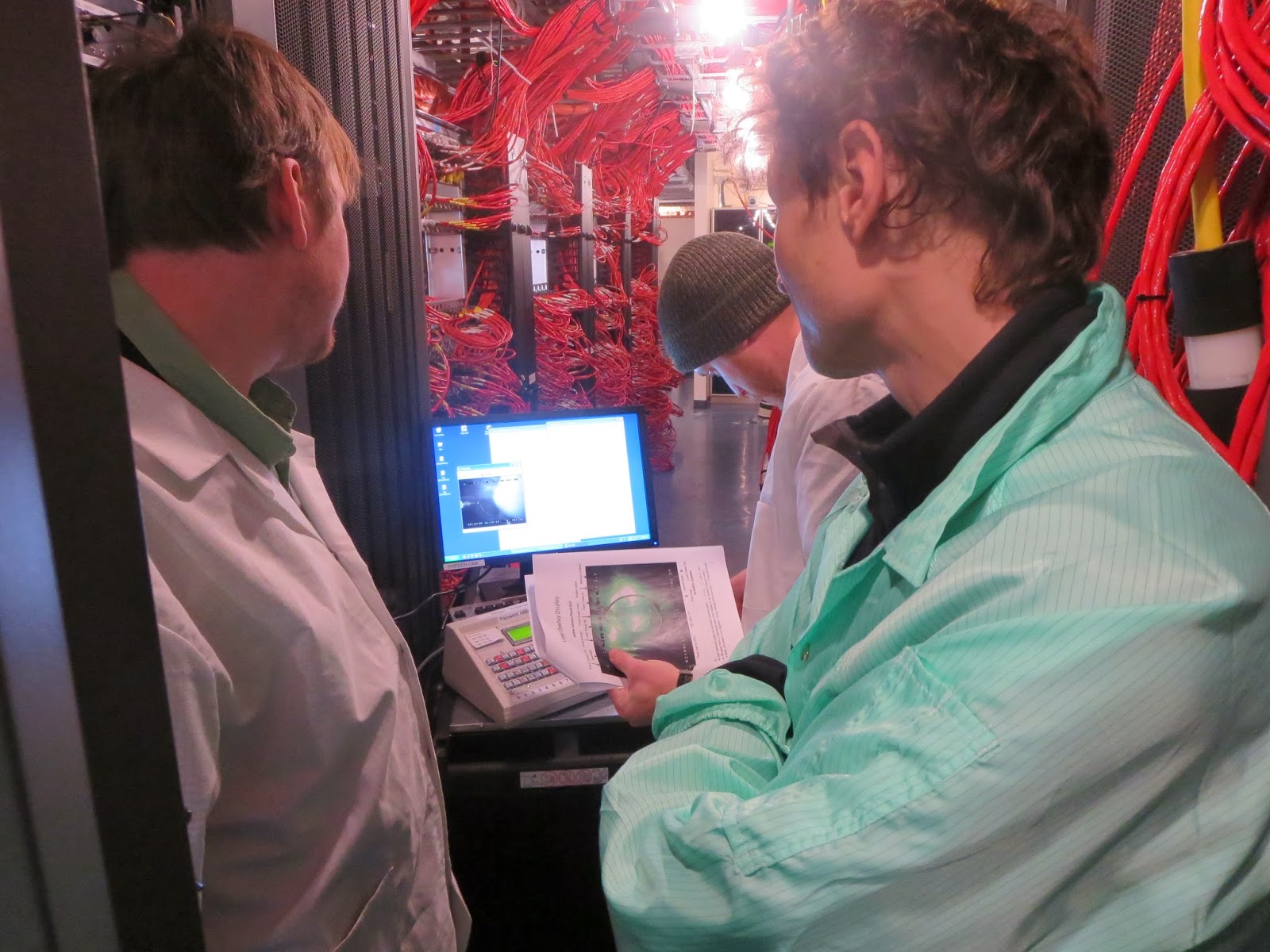
One that's still in use is the Swedish camera. This is actually a pair of cameras on the same section of cable between two DOMs, the lower one pointing up and the other pointing down. These cameras were used to visually inspect the freeze-in process and are still turned on every year or so to chart how the ice changes as it solidifies.


The process to use these cameras is somewhat involved. Because it's a visual inspection, we need to turn on the cameras' lights. However, the DOMs are very sensitive so we turn off all but the most remote DOMs or they might be overloaded and stop working!

Because there is light in the detector, the data taken while the Swedish camera is running isn't useful for most normal science, but we keep that outer ring of DOMs going just in case there's a supernova somewhere "near by". The last close supernova happened in 1987. Twenty four neutrinos emitted by that event were recorded and physicists were able to massively increase their knowledge of neutrinos and the universe from those few particles. We're overdue for a supernova in our galaxy, so we need to keep the detector taking data as continuously as possible in order to catch that supernova's particles when they hit earth.


If you're interested, you can read the weekly report from three years ago when the Swedish camera was deployed, and see a better image from the Swedish camera.

Friday, December 06, 2013

Stationary

Pretty boring day today. I got up and discovered the GOES satellite link was GONE again. I got dressed and performed my morning ablutions then gobbled a double chocolate muffin before working out. Since I had a shower a couple of days ago I got dressed right after I worked out and headed into B2, where I've been planted ever since.

Fortunately I've got a few pics squirreled away. Here are a couple of pictures of summer camp. These are insulated plywood and canvas buildings used when there are a lot of people here. The station population is low enough that everyone gets a room on station, but back in IceCube drilling days I stayed out here a couple of times.


Here's the back side of one of the summer camp buildings. Snow blows in all winter and unless it's cleared away it will eventually bury anything that sticks above ground.


The traverse guys mark their trail with flags like those around this building and some those were barely visible when they made the first trip this year!

Thursday, December 05, 2013

Satellite woes

This morning I'd planned to moderate the weekly DAQ call and then join Ralf in B2 to help switch the DAQ control server to a new machine. Unfortunately, the satellite didn't cooperate with the former and almost sabotaged the latter.

When I woke before 7AM, the GOES satellite connection was out so we had no connection to the Internet or the phone network. There are a few satellites which cover the South Pole, but it's rare that they overlap so we have backup when one connection fails:


My call was scheduled for 8:30AM this morning (1:30PM CDT) but GOES wasn't up so I had to cancel the call. Fortunately, there is a way for email to leak out. There is an extremely slow link to the rest of the work via the Iridium satellite networkover which e-mail messages below a certain size can be sent almost immediately.

At 8:45AM the GOES link was fixed, so we moved on to the server work and after some preparation we finished very quickly, missing only three and a half minutes of IceCube detector data!

I'll be busy the rest of the day preparing for the next few server switches. One is happening this afternoon but it's pretty simple and I'm estimating that we'll have less than a minute of downtime.

For today's fun South Pole shots, here are a couple of shots taken while I walked to the IceCube Lab. First, a view of the ICL. This building was actually one of a set of dorms back before the current station was built. Once the station became habitable, they parceled the buildings out to several different experiments.


Here's a view, taken from the same spot, looking back at the station. The station is on the left, assorted buildings are visible in the middle, and the berms (the warehouse district of the Pole where things are stashed for long-term storage) are on the far right. You might be able to see several sets of flags scattered around the snowscape. Those are markers for the IceCube strings and icetop stations!

Wednesday, December 04, 2013

Big boom!

Yesterday some experts detonated some explosives planted around the old station (the original station built in the 50s) in an attempt to further collapse the snow in that area. Parts of the old station are still there under loads of snow which leads to a treacherous situation. A year or two ago, a bulldozer was grooming the old station area when a section collapsed and it took a great deal of effort to pull out that bulldozer. Thus the decision to try to fully collapse the snow over the old station.

For me, this is not just a safety measure, it's an opportunity for a cool show!

We left the IceCube Lab 15 minutes before the scheduled time and walked 100 yards or so to the South Pole Telescope building, which is the closest building to the explosions.


At SPT, we went inside to warm up a bit, then climbed the outside stairs to the roof.


A decent crowd of spectators assembled there, including several of the Traverse guys, all with cameras ready to capture the action.


The team of experts took a while to get everything ready but after about 10 minutes the station announced that blasting would begin in 1 minute. I got my camera out of my warm jacket and started taking video 30 seconds before "explosion time".

About 20 seconds after the scheduled time, one of the experts started walking back toward the point where all the wires were connected, so there was obviously a technical problem. I stopped recording and put my camera back in my jacket. The extreme cold drains batteries quickly and 50 seconds or so of video had depleted about two-thirds of my camera's battery !

After some work, the expert walked back to the group and soon one of them shouted out "Fire in the hole. In ten ... nine ...", so I got my camera back out and started filming again. The countdown reached zero and ... nothing again. By this point my camera's battery indicator was flashing red!

After another trip out to work on the connections, without any other warning someone just shouted "Fire in the hole!" and the explosion went off!


There was a satisfying spray of snow and a definite BOOM, accompanied by a groan from the crowd that we weren't able to get any pictures!


I know they weren't there to entertain us but still....


After the explosion, people milled around a bit but we had been standing on top of the building in the wind for about half an hour so everyone left pretty quickly. Ralf offered my a ride back to the station on the sled attached to his snow machine, but I hadn't brought a helmet. One of the traverse guys overhead that conversation and said he was driving past the station if I'd like a ride, so I got to ride back in one of the traverse vehicles!!!

Tuesday, December 03, 2013

We are not alone

We have visitors today! There is a "tourist camp" for the small stream of visitors to the Pole. It normally looks like this:

There's a solar toilet and a small building which acts as the visitors' center. Visitors can request a station tour (which I believe includes a free South Pole cookie) and stop by the station store to purchase souvenirs, but they're not allowed to sleep on station (unless it's a life threatening emergency).

These visitors (the first this season?) are the support crew for the Willis Resilience Expedition. A 19 year old is attempting to set a speed record for skiing from the coast to the Pole.

The current visitors are just taking a quick 8 hour nap before heading out on the next leg of their trip, so this may just be the crew scouting the route before the actual attempt. They'll apparently be back in 3-4 weeks so I'll miss the final visit.

I'll also likely miss Prince Harry's arrival though I'm more upset about not seeing Dominic West who is on the same trip. A co-worker noted that it'd have been even more fun if West's fellow The Wire actor Michael K. Williams were coming, then we could wander around the station saying "Omar coming"

Monday, December 02, 2013

Late night

I've had a short day today and the last satellite pass is coming to an end, so this will be a quick post.

The phone in my room rang at 1AM this morning. The detector was having problems. I stumbled from my room to B2 and Ralf (a former IceCube winter-over and current IT expert), Ian (current IceCube winter-over), and I tried to puzzle out what was wrong.

We eventually involved John, an expert in the North (well, the Northern Hemisphere ... everywhere is north from here) and have a rough idea of the problem, though we don't have a fix yet.

I got back to sleep by 5AM, woke up again at 9:30AM and managed to get in a 35 minute session on the elliptical machine before lunch!

The station had plans to do some blasting at the Old Station today but those were postponed until tomorrow.

Here's a quick pic of the view out my room window. If you go back and look at the picture I posted of my room, it may not be obvious that I have a window. That's because the dorm room windows are usually covered up with cardboard to block out the 24 hour sun.

Sunday, December 01, 2013

Traverse Open House

Yesterday the South Pole Traverse team held an open house, allowing us stationary folk a chance to sample the Antarctic commuter lifestyle. The main purpose of the traverse is to deliver huge bladders of fuel, eight 4000 gallon bladders per tractor. The statistic I've heard is that one traverse can transport 40 flights of fuel.

There are eight tractors hauling fuel along with a couple of other tractors hauling their living quarters, cargo trailer, etc. They use both Case and Caterpillar tractors.


here's also a vehicle they use for deep scanning of the snow ahead. The route is pretty well established by now, but we do dwell on a huge moving sheet of ice and crevasses can open up over a year's time, so the first traverse is careful to scan the route and make sure it's safe.

The border between the Ross Ice Shelf and the McMurdo Ice Shelf is particularly hazardous, though the guide also mentioned something dubbed the Sastrugi National Forest which sounds like it would be an awesome place to see.

They're not the only guys driving around Antarctica. The guide mentioned Russia, Greenland, and other countries, and he said the Greenland guys really know their stuff so our guys try to steal all the Greenlanders' best ideas :-)

The traverse has some of the comforts of civilization, including a laundry room and bathroom with shower. Per the Antarctic treaty they haul their "waste" back to McMurdo for disposal. The guide mentioned that, unlike Polies, they're not limited to a 2 minute shower but they do need to fill the snow melter for their showers so the length of their shower is limited by their desire to shovel snow.

There's also a kitchen where they eat and hold group meetings. Cooking duty rotates through the entire crew, but the evening cook is excused from fueling and servicing duties when they stop each night.

They can even do some outdoor cooking when the mood strikes them.
This traverse set a new record, taking only 19 days to drive from McMurdo to the Pole. In future years they may move to driving 24 hours a day to decrease the driving time, so they can jam more runs into each season. They'll also be driving to more sites around the continent. And the coolest possibility, they're looking into semi-autonomous vehicles -- a human would drive the lead vehicle and the automated vehicles would follow its path.


If you want to read more about the traverse, one of the guys is keeping a blog about his journey at http://beyondthebackyard.com.

Saturday, November 30, 2013

My social calendar is full

It's Sunday, and for most people it's a day off. I tend to work Sunday as well because my time down here is so limited, but I'm definitely having a lazy day today.

Last night the documentary "Antarctica: A Year on Ice" was shown in the gym. Popcorn was available for free, but everyone had to bring their own seat. It's a fun movie centered around life at McMurdo, with some really beautiful shots of snowscapes, Aurora Australis, and other subjects, and a lot of nice detail about living and working in Antarctica.

I got almost 7 hours of sleep which counts as a luxurious night's rest at the South Pole, then puttered around (procrastinated, really) to avoid working out until I noticed that it was 11:30 and brunch ended at 12:30. So I rushed in and logged 35 minutes on the elliptical then hit the galley for a fresh-made omelet and a couple of cinnamon rolls.

After lunch, it was shower time again, my second since I arrived on the 21st. By the time I was done, it was almost 2:15 so I hustled out to the traverse camp where they were giving tours until 3PM. I'll post pictures of that tour soon when I have more satellite time.

One exciting bit of news. The traverse guys have a drill they use to figure out deep crevasses are and also to plant explosives. On Monday and Tuesday they'll be planting explosives around the old station to try and cave in some of the more treacherous areas. On Tuesday at noon they'll set off all the explosives. Woo-hoo, South Pole fireworks!

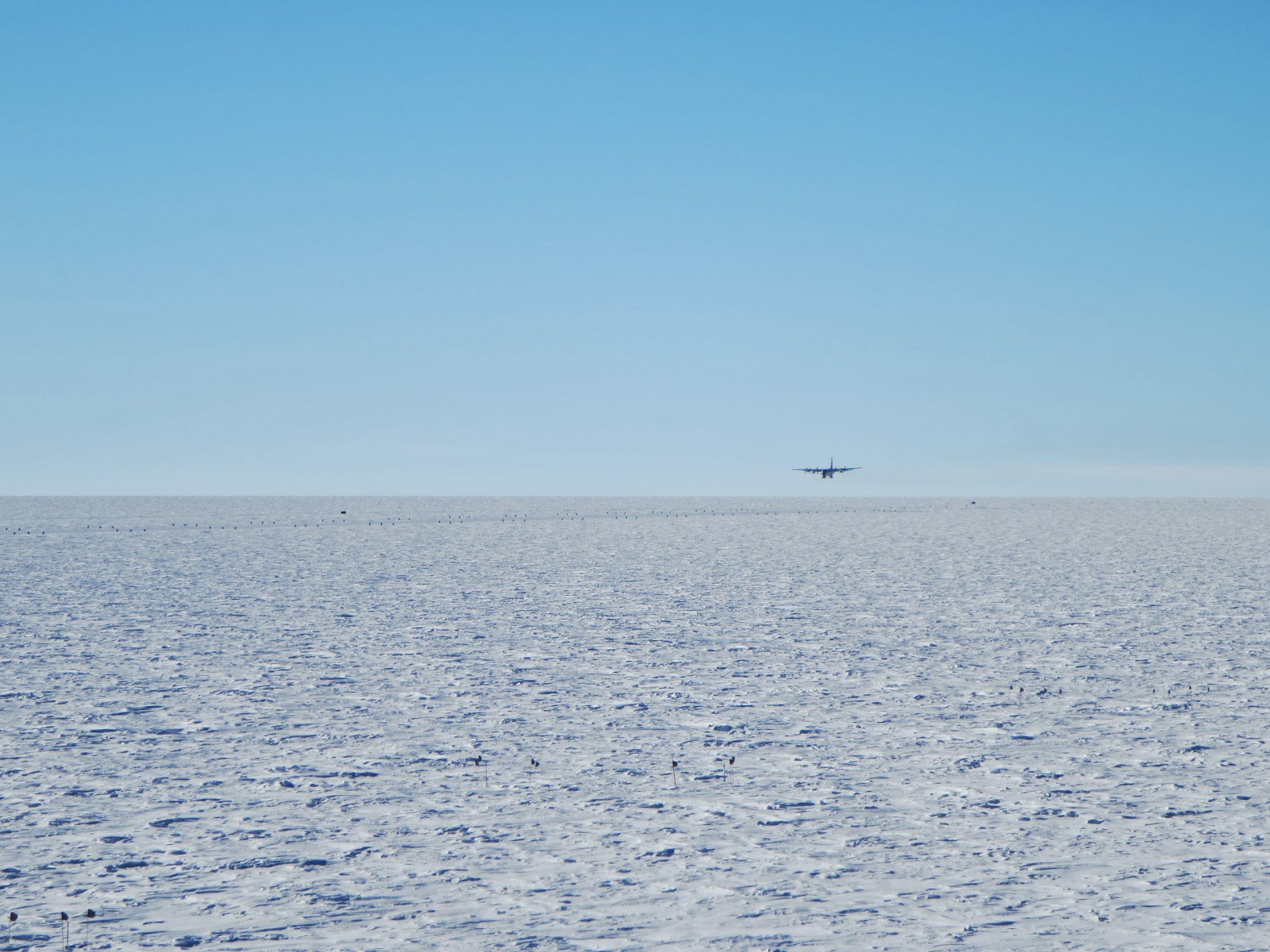
For today's pictures we have one of the flights landing on the ice runway. Note that these planes have skis instead of wheels:


Here are some passengers waiting to leave the South Pole. Note the luxurious departure lounge where passengers relax in comfort while the incoming cargo is pulled off the plane and the outgoing cargo is loaded onto the plane.

Actually the black building to the left of that group of people really is a departure lounge, but it's not much more than a box where you can hide from the wind.

Friday, November 29, 2013

Busy day

We had a busy day today out at the IceCube lab trying to run the Sweden camera (more later).

In lieu of a real post, here are a couple of pictures of the IceCube guys waiting outside the ICL before heading back to the station
Since the satellite

Thursday, November 28, 2013

Happy Thanksgiving!

Hope you all had a happy Thanksgiving! Here's a South Pole selfie to remind you that you're thankful you're home with family instead of here with me :-)


Also, the usual shot of that famous South Pole landmark, Spoolhenge!

Wednesday, November 27, 2013

Water, water nowhere

The power outage that temporarily knocked the IceCube detector offline also took out the station's water pump. This is unfortunate, because it's the main source of water for the entire station. As a result, we've been on water rationing since yesterday morning, meaning no showers or laundry and paper plates/cups and plasticware in the galley. Rumors seem to indicate that it'll be fixed today.

The water is provided via a Rodriguez well (or "Rod well"), where a hole is drilled into the ice and then enough heated water is circulated in the hole to keep the station supplied with water and to keep the hole from freezing.

Coincidentally, a group from Wisconsin is drilling a new access hole into the Rod well. They'd normally be out drilling holes for the new Askaryan Radio Array, but due to the government shutdown several projects were cancelled for this season, including ARA.


That big hanging thing on the right side of the picture is the firn drill, which was built back in the IceCube drilling days to melt through the firn layer, the initial layer of snow on top of the 2 km of ice.


The firn drill is essentially a big, pointy radiator. Hot water is circulated through the copper tubing and the drill melts its way down.